Green Gecko Logo

News & Events

Updates, activities, and project milestones from the Green Gecko network.

Project activities · 2026

Learning together. Advancing climate action.

Follow the Green GECKO consortium’s study visits, partner meetings, and international webinars.

International study visit

Torino & Madrid

Green GECKO Study Tour Bridges Italy and Spain to Advance Sustainable Engineering Curricula
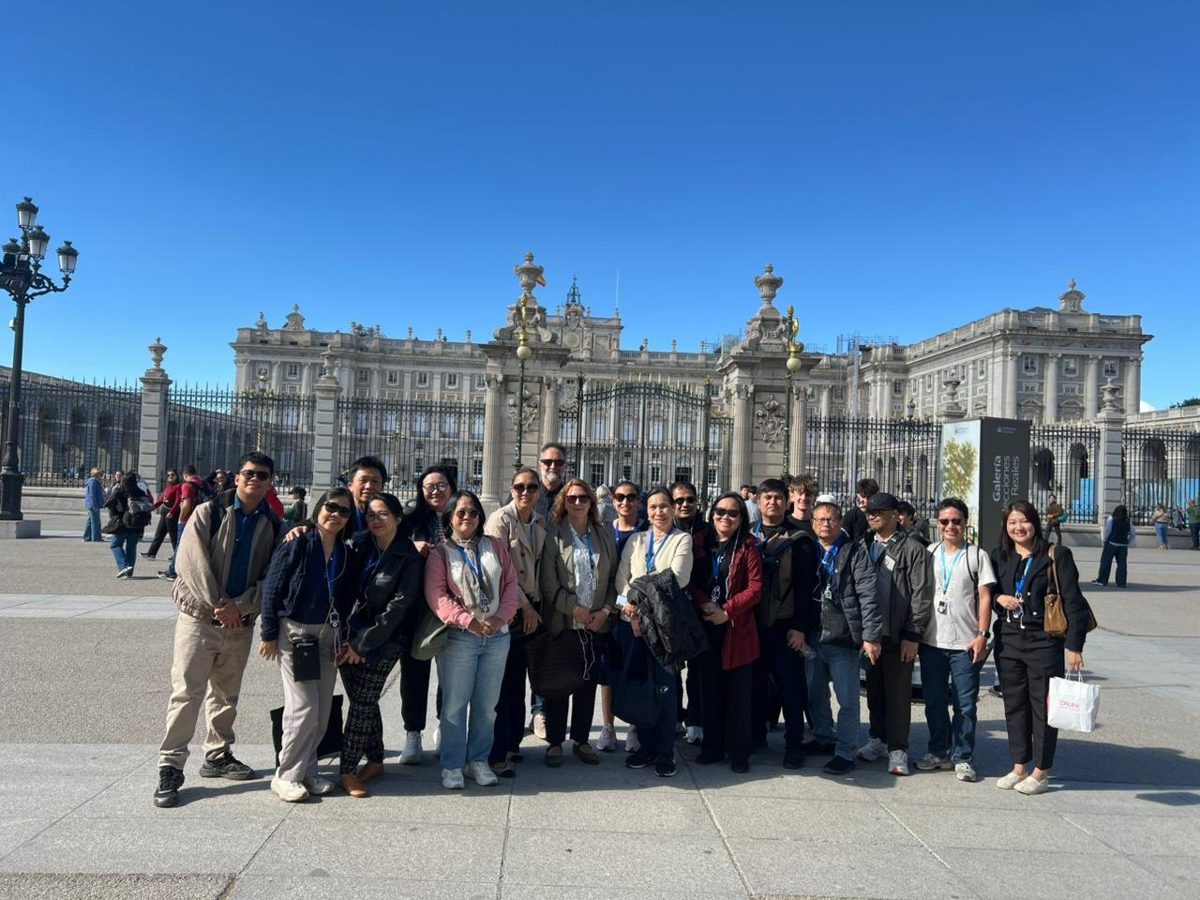
Partners explored sustainable engineering, innovative teaching, and digital learning at Politecnico di Torino and UNED.

Read full storyClose story

TORINO & MADRID — Building regional capacity to equip Southeast Asia’s next-generation engineers for climate action and carbon neutrality, representatives from the Green GECKO consortium completed a multi-destination European study visit across Italy and Spain.

The first leg of the mission was hosted by Politecnico di Torino (PoliTO) in Italy from April 27 to 30, 2026, followed by strategic sessions with Spain’s Universidad Nacional de EducaciÃģn a Distancia (UNED) in Madrid. Co-funded by the Erasmus+ Programme of the European Union, the project brings together 12 universities from France, Italy, Spain, Lithuania, Thailand, and the Philippines under the coordination of the University of Montpellier.

Hands-on Innovation and Sustainable Campus Practices at PoliTO

The Torino program opened at the Department of Management and Production Engineering (DIGEP), hosted by Prof. Cristina Marullo and Prof. Chiara Ravetti. Over four days, participants engaged with key faculty on attitudinal education and experiential teaching models, beginning with an overview of PoliTO Plus by Prof. Emilio Paolucci and a panel discussion on modern engineering pedagogy featuring Prof. Luciano Rolando, Prof. Giuseppe Tipaldo, and Ing. Beina Bleta.

Prof. Patrizia Lombardi, Vice Rector for Sustainable Campus and Living Lab, welcomed delegates for an institutional tour highlighting PoliTO’s carbon-neutral campus solutions, followed by technical demonstrations at the Drawing to the Future Lab (DISEG) led by Prof. Anna Osello.

High-level institutional engagements continued at the Rectorate with Vice Rector for International Affairs Prof. Alberto Giuseppe Sapora, DIGEP Head Prof. Maurizio Galetto, Prof. Luca Mastrogiacomo, and Entrepreneurship and Innovation Center (EIC) Director Prof. Alessandra Colombelli. Delegates also gained insights into the Alta Scuola Politecnica (ASP) Honours Programme with Director Prof. Elisabetta Raguseo and directly observed the interactive Sustainable Business Game, which models circular economy decision-making for engineering students.

Collaborative Module Design and Technical Explorations

A central deliverable of the visit was the dedicated working session: Brainstorming on the Creation of Green GECKO Innovative Modules. Academic partners collaborated on course architecture, structuring practical learning outcomes in renewable energy, industrial sustainability, and circular production systems to be piloted across universities in Thailand and the Philippines.

The delegation also toured cutting-edge applied research hubs in Turin:

The Center for Automotive Research and Sustainable Mobility (CARS).

The DIATI Hydraulics and Fluid Mechanics Laboratory, featuring a natural disaster prevention demonstration by the student team "MI LEGO al territorio" led by Fabio Carlacchiani.

The landmark PoliTO Energy Center, showcasing multidisciplinary research in clean power generation and urban energy transition.

Distance Pedagogy, Scalability, and Digital Inclusion at UNED

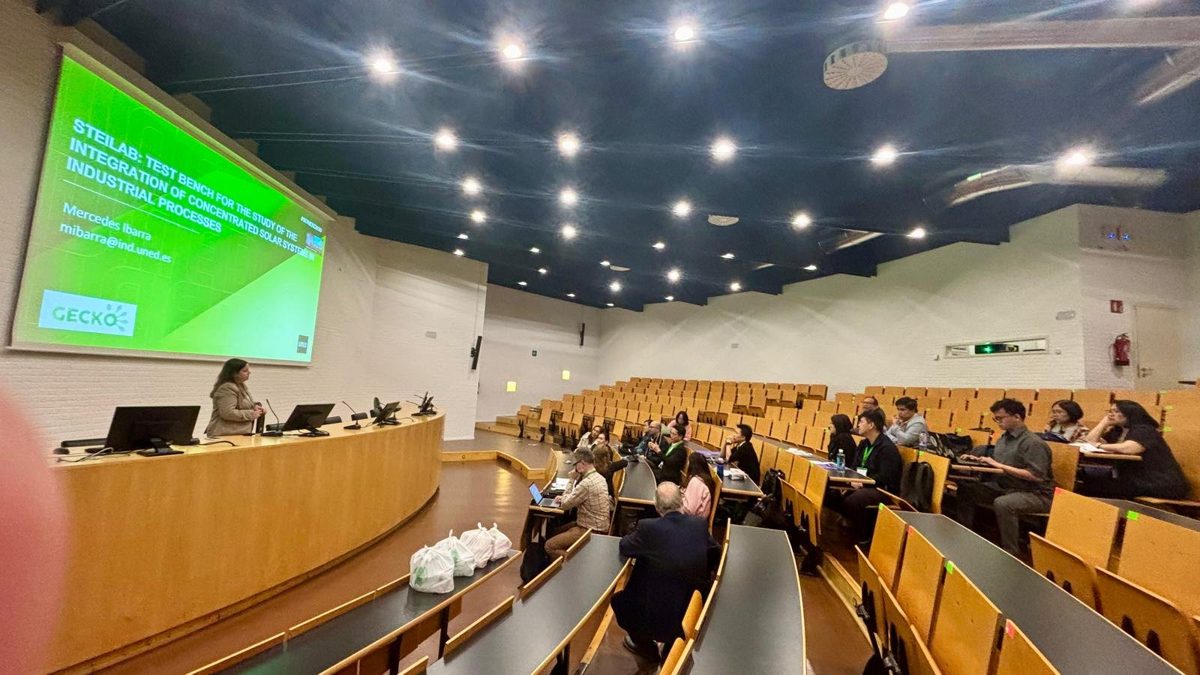
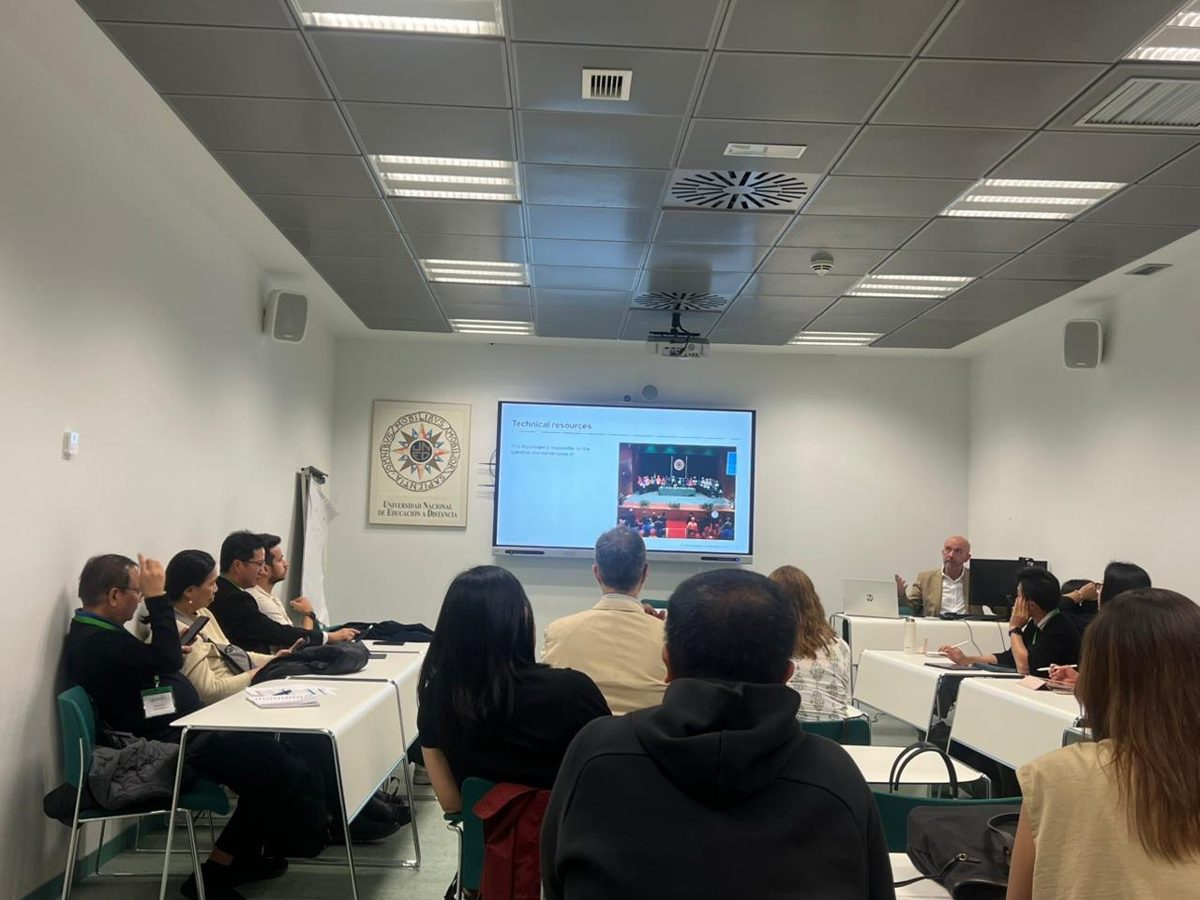
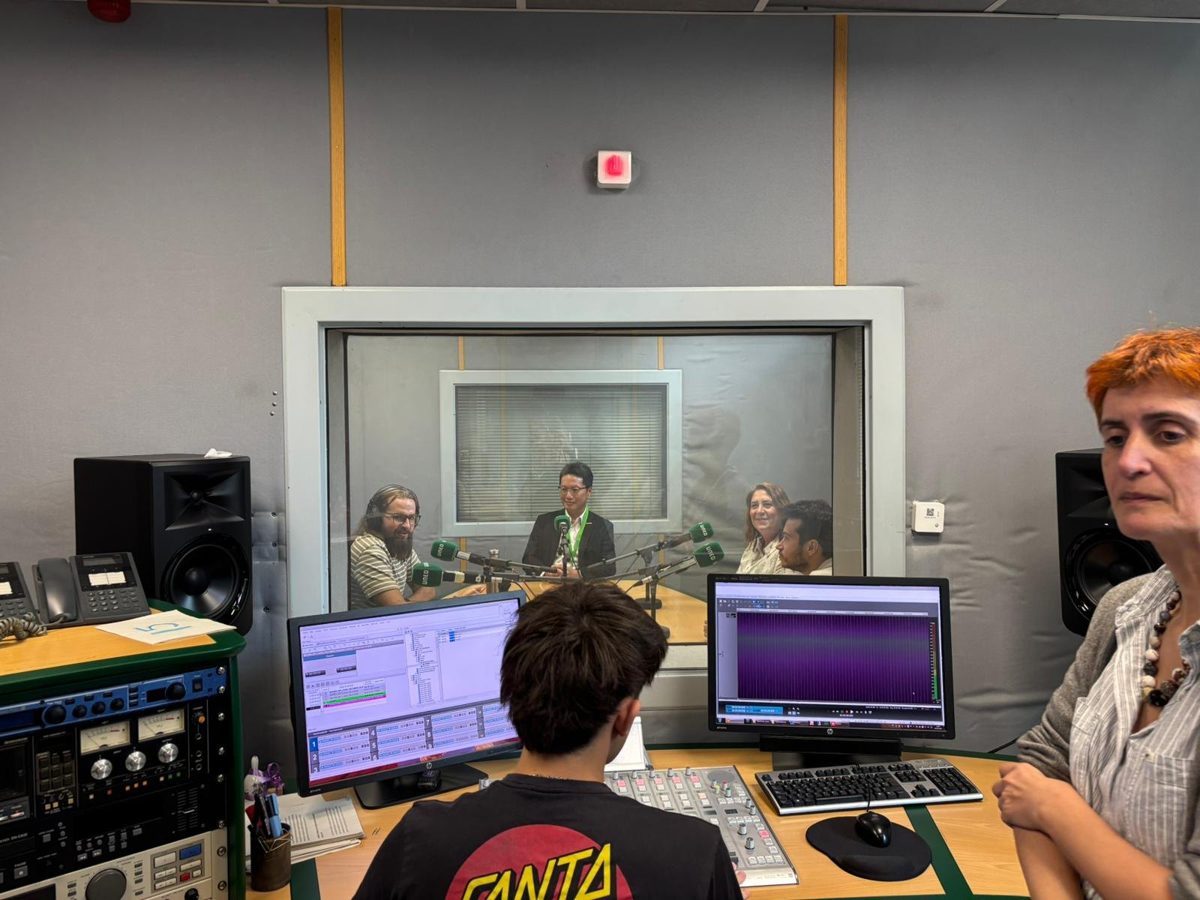
Continuing from Turin, the delegation engaged with team members at the Universidad Nacional de EducaciÃģn a Distancia (UNED) in Madrid. As Europe’s premier distance-learning institution, UNED shared specialized frameworks for modernizing cross-border curricula:

Remote & Hybrid Delivery Platforms: Demonstrations of digital learning environments, virtual labs, and flexible instructional methodologies designed to reach student cohorts across diverse campuses.

Curriculum Adaptation & Modularization: Mapping the learning frameworks established in Turin into stackable, accessible micro-credentials and hybrid modules suitable for Southeast Asian partner institutions.

Quality Assurance & Open Resources: Establishing joint evaluation protocols to ensure long-term pedagogical sustainability, open educational resources (OER), and industry-aligned assessment criteria.

Charting the Next Phase of Green Engineering

The cross-border study visits in Italy and Spain mark a pivotal transition from conceptual design to curriculum authoring within the Green GECKO initiative. Over the coming months, consortium working groups will refine course syllabi, develop instructional materials, and establish local industry advisory councils ahead of scheduled pilot implementations across Southeast Asian partner universities.

About the Project & Consortium

The Green GECKO project (Capacity Building in Higher Education, Project No. 101236657) is funded under the European Union’s Erasmus+ Programme.

Coordinator: UniversitÃĐ de Montpellier (France)

European Partners: Politecnico di Torino (Italy), Universidad Nacional de EducaciÃģn a Distancia – UNED (Spain), Vilnius University (Lithuania)

Partner Institutions in Thailand: Burapha University, Kasetsart University, Silpakorn University, Ubon Ratchathani University

Partner Institutions in the Philippines: University of the Philippines System, Technological Institute of the Philippines, Ateneo de Manila University, Xavier University

Back to activities ↑
Consortium partner meeting

Burapha University · Chonburi, Thailand

Green GECKO Consortium Convenes in Chonburi to Finalize Climate Engineering Modules and Roadmap

The consortium met at Burapha University to advance climate engineering modules and coordinate the next international training activities.

Read full storyClose story

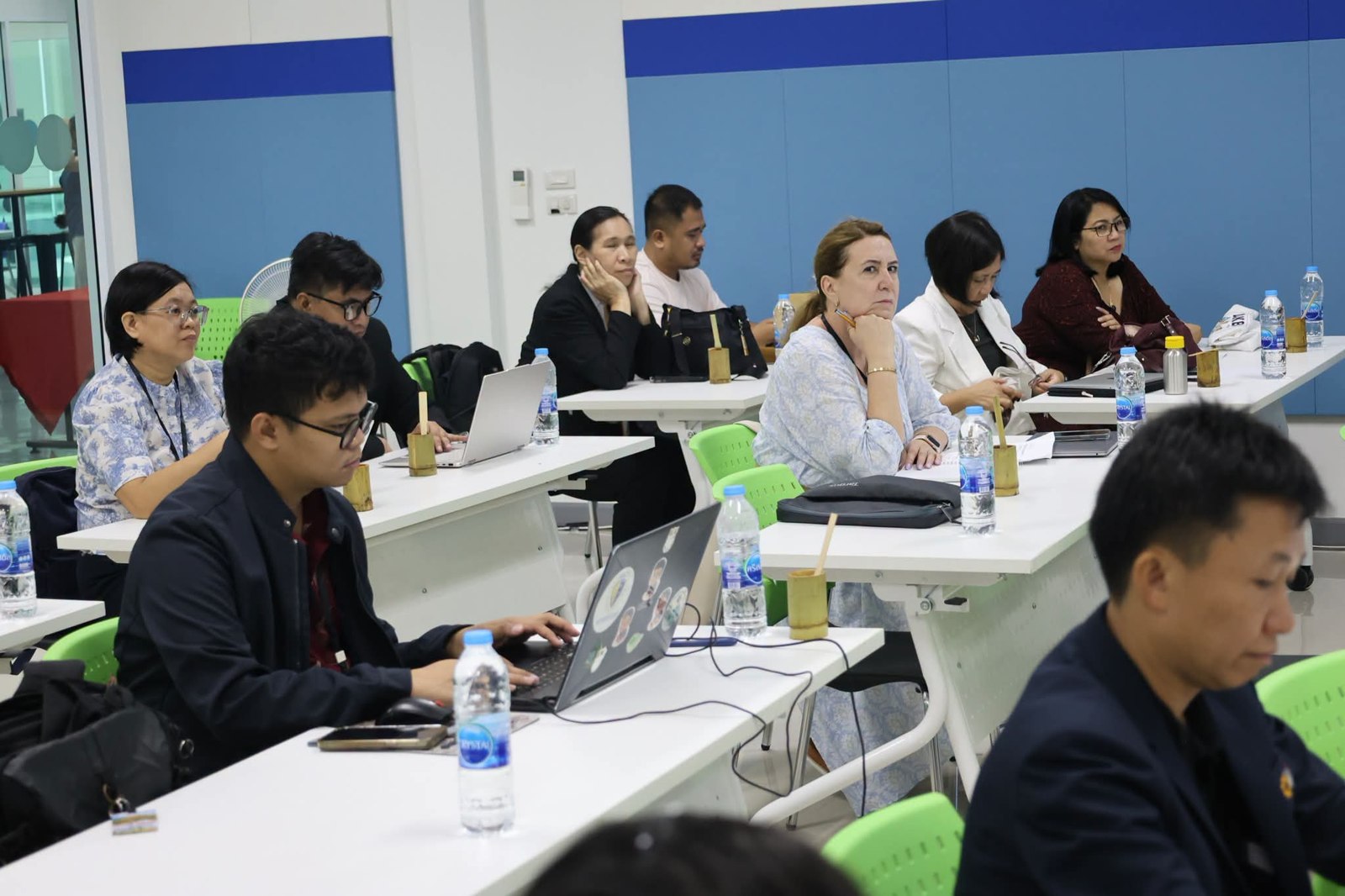
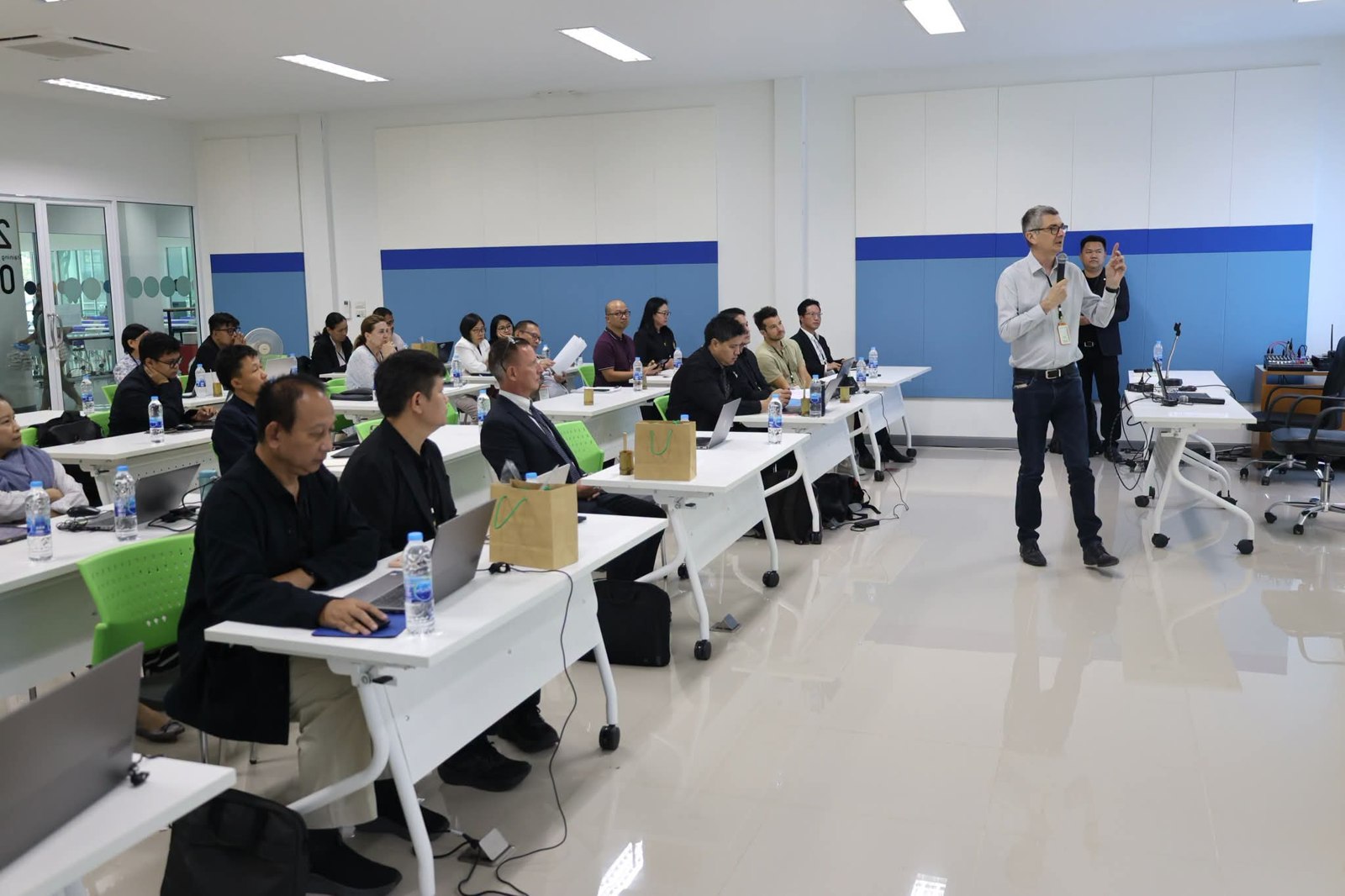
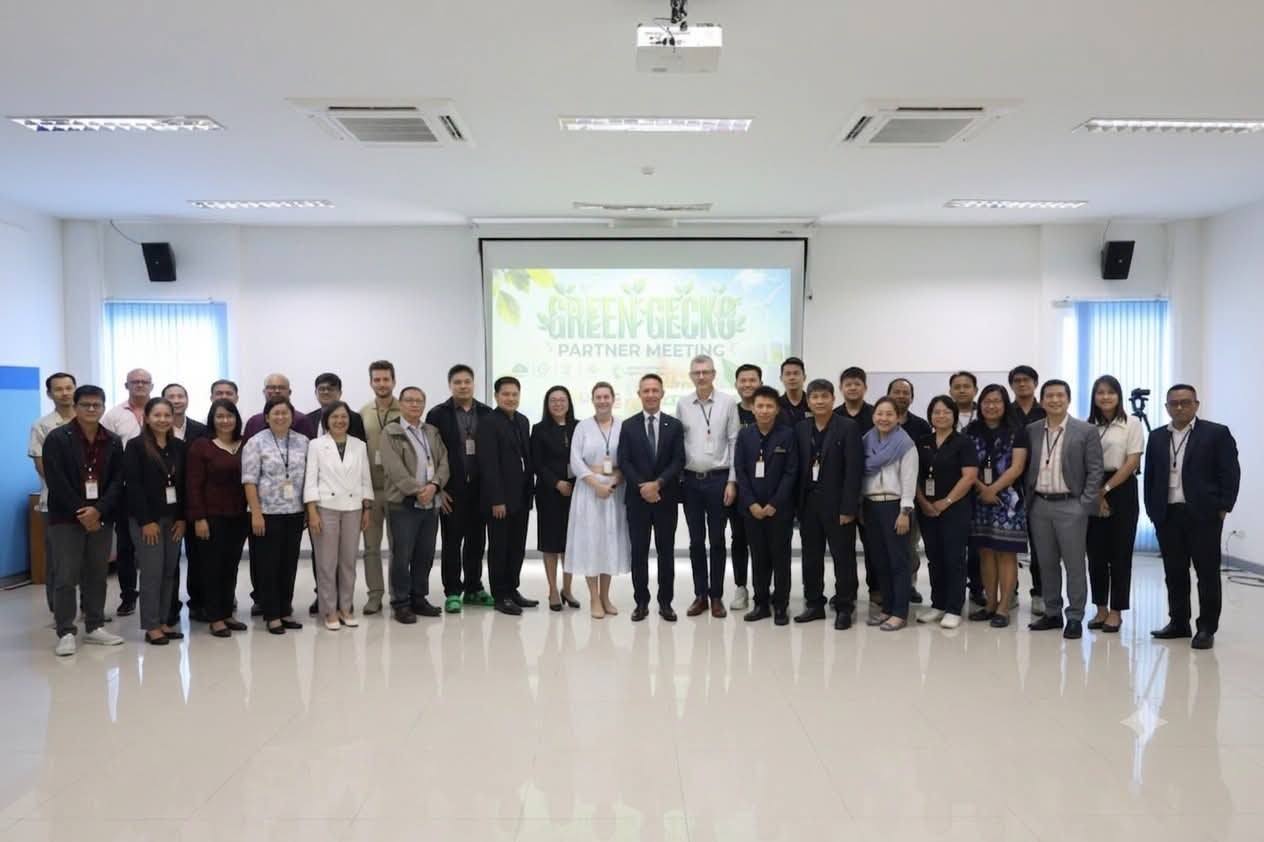
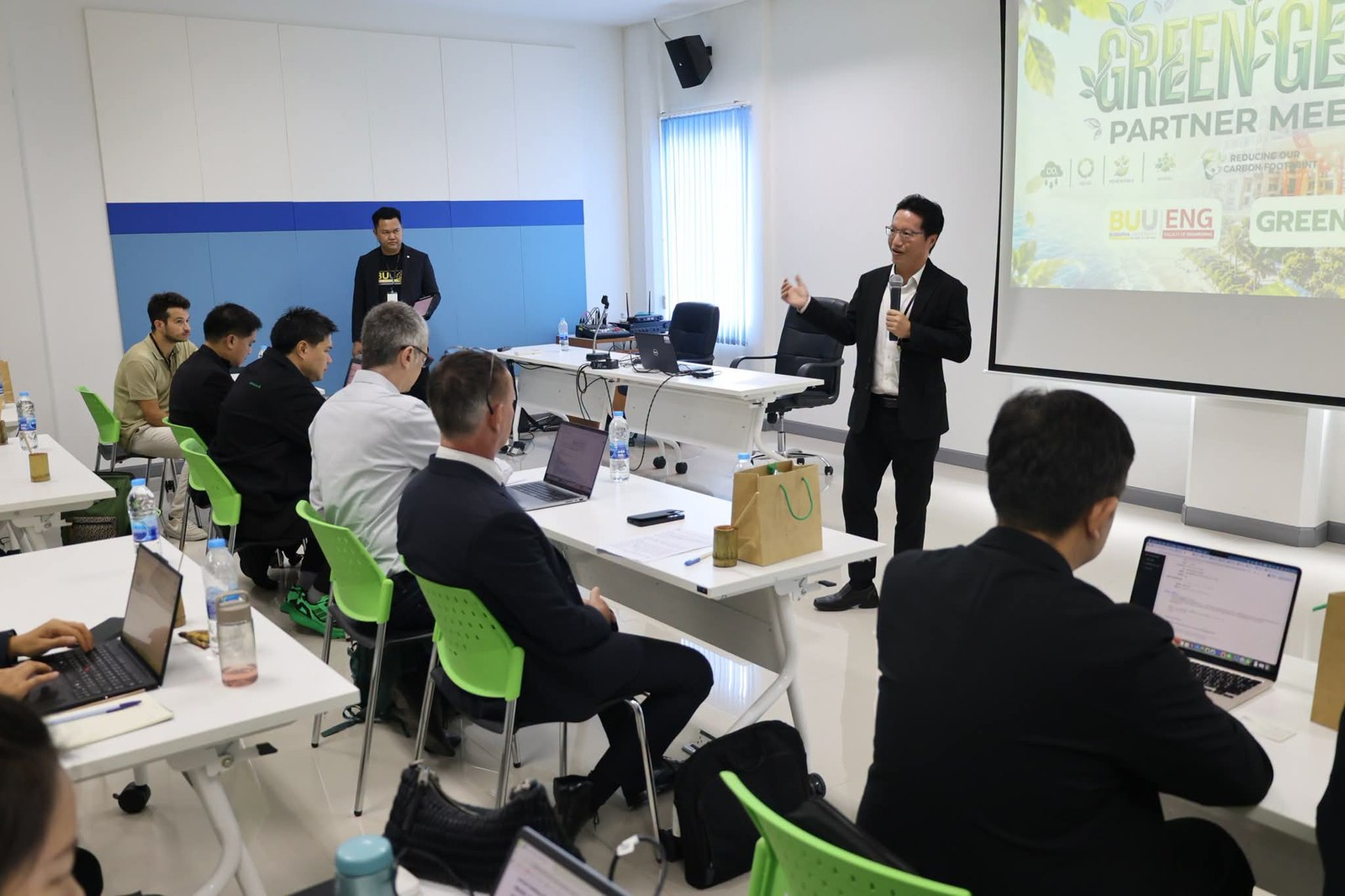
CHONBURI, Thailand — Marking a major project milestone, international partners of the Green GECKO project gathered at Burapha University’s Faculty of Engineering from July 5 to 7, 2026, for the project's official Partner Meeting. Co-funded by the Erasmus+ Programme of the European Union, the gathering brought together European and Southeast Asian academic institutions to review modular course developments, coordinate external stakeholder roundtables, and map out the next cycle of global training workshops.

Hosted at the cutting-edge Automation Park Building on the Bang Saen campus, the meeting advanced curriculum structures aimed at training engineering students across Thailand and the Philippines in climate change mitigation, greenhouse gas (GHG) accounting, and carbon neutrality.

High-Level Welcome and Institutional Backing

The official proceedings commenced on Monday, July 6, with opening addresses emphasizing the urgency of international academic synergy:

Asst. Prof. Dr. Nayot Kurukitkoson, Dean of the Faculty of Engineering at Burapha University, formally welcomed international delegates, highlighting the university’s dedication to sustainable engineering and regional educational innovation.

Dr. Ludovic Andres, Scientific and Academic Cooperation Officer at the Embassy of France in Thailand, delivered a welcome speech underscoring the vital role of Franco-Thai and European-ASEAN higher education alliances in addressing climate challenges.

Dr. Thanongsak presented the meeting program, outlining the working objectives and technical targets for the three-day convention.

In-Depth Modular Presentations: From Policy to Net Zero

The core working sessions on July 6 were dedicated to comprehensive presentations by module development leaders from partner institutions across Thailand and the Philippines. Each team detailed learning objectives, pedagogical approaches, and localized case studies across key focus areas:

Module 1 (Climate Change Fundamentals): Kasetsart University (KU) introduced fundamental concepts and the global imperative of climate action.

Module 2 (Policy, Frameworks & GHG Sources): Technological Institute of the Philippines (TIP) outlined international policy mechanisms and industrial emission profiles.

Module 3 (GHG Accounting & IPCC Guidelines): Xavier University (XU) detailed methodologies based on international IPCC reporting standards.

Modules 4 & 5 (Carbon Footprint of Organization & Product / LCA): Burapha University (BUU) presented organizational GHG accounting frameworks and life cycle assessment (LCA) methodologies.

Energy Management & Resource Efficiency: Ateneo de Manila University (ADMU) detailed industrial energy conservation strategies.

Low-Carbon Engineering Technologies: Ubon Ratchathani University (UBU) outlined emerging low-carbon applications.

Carbon Credits & Market Mechanisms: Silpakorn University (SU) covered voluntary and compliance carbon credit markets.

Net Zero Engineering: University of the Philippines (UP) framed holistic pathway engineering toward net-zero targets.

Industrial Case Studies: Presented jointly by Ubon Ratchathani University and Burapha University to bridge theoretical calculations with real-world enterprise implementation.

The day concluded with dedicated exchange sessions with Thai industry partners and associated external stakeholders, followed by an official welcome dinner celebrating regional partnerships.

Quality Assurance, Governance, and Future Roadmap

On July 7, consortium members focused on project governance, educational quality control, and strategic management. In parallel, discussions engaged external stakeholders from the Philippines to ensure cross-border curricular alignment.

Key strategic outcomes reached during the management deliberations include:

Finalized Schedule for International Training Workshops:

Training 1: UniversitÃĐ de Montpellier (UM), France — November 30 to December 4, 2026

Training 4: Xavier University (XU), Cagayan de Oro, Philippines — March 15 to March 19, 2027 (scheduled ahead to maximize regional climate favorability)

Training 2: Burapha University (BUU), Bang Saen, Thailand — May 10 to May 14, 2027

Training 3: Ubon Ratchathani University (UBU), Thailand — May 17 to May 21, 2027 (arranged back-to-back with BUU to optimize travel logistics)

Upcoming International Webinar Series: The consortium agreed to host four specialized public webinars across September and October, covering climate change basics, GHG accounting, low-carbon energy management, and net-zero circular economy engineering.

Monitoring & Continuous Follow-Up: Partners instituted regular monthly coordination meetings, coupled with a pre-training diagnostic framework spearheaded by Xavier University to ensure tailored workshop delivery and prevent thematic overlaps.

Delegates concluded their stay in Chonburi with a study visit to the renowned Institute of Marine Science (Bangsaen Aquarium), blending academic rigor with local marine ecological immersion.

About Green GECKO

The Green GECKO project (Co-funded by the European Union under Erasmus+ Capacity Building in Higher Education) bridges European expertise with leading Southeast Asian universities. Led by the University of Montpellier (France), the consortium unites Politecnico di Torino (Italy), UNED (Spain), Vilnius University (Lithuania), Burapha University, Kasetsart University, Silpakorn University, Ubon Ratchathani University (Thailand), alongside the University of the Philippines, Technological Institute of the Philippines, Ateneo de Manila University, and Xavier University (Philippines).

Back to activities ↑

International webinar

Online · Hosted by Ateneo de Manila University

Green GECKO Webinar Series Debuts with Nearly 300 Participants Across ASEAN and Europe

Nearly 300 participants joined the opening webinar on climate change and greenhouse gas emissions in global and ASEAN contexts.

Read full storyClose story

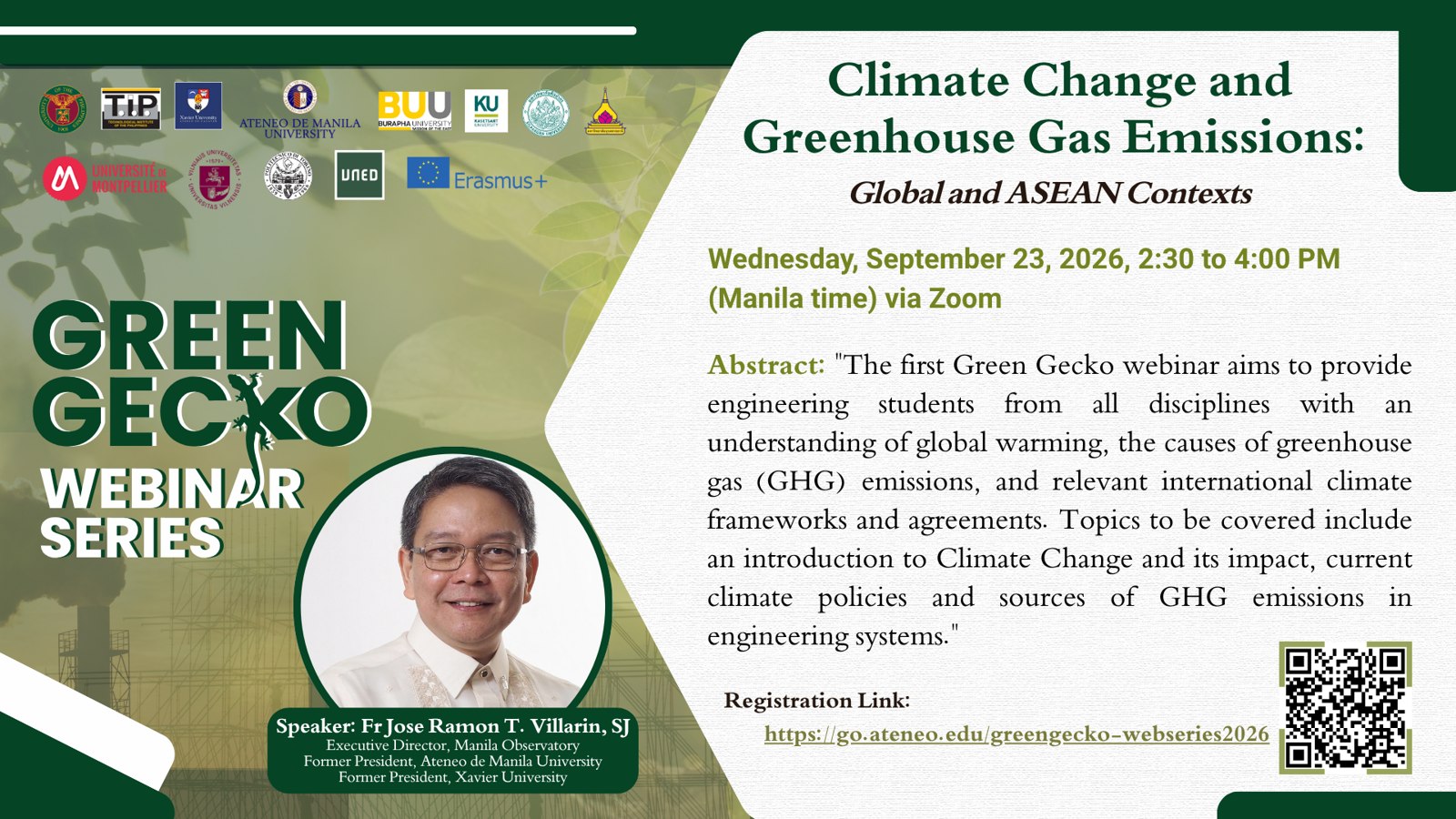
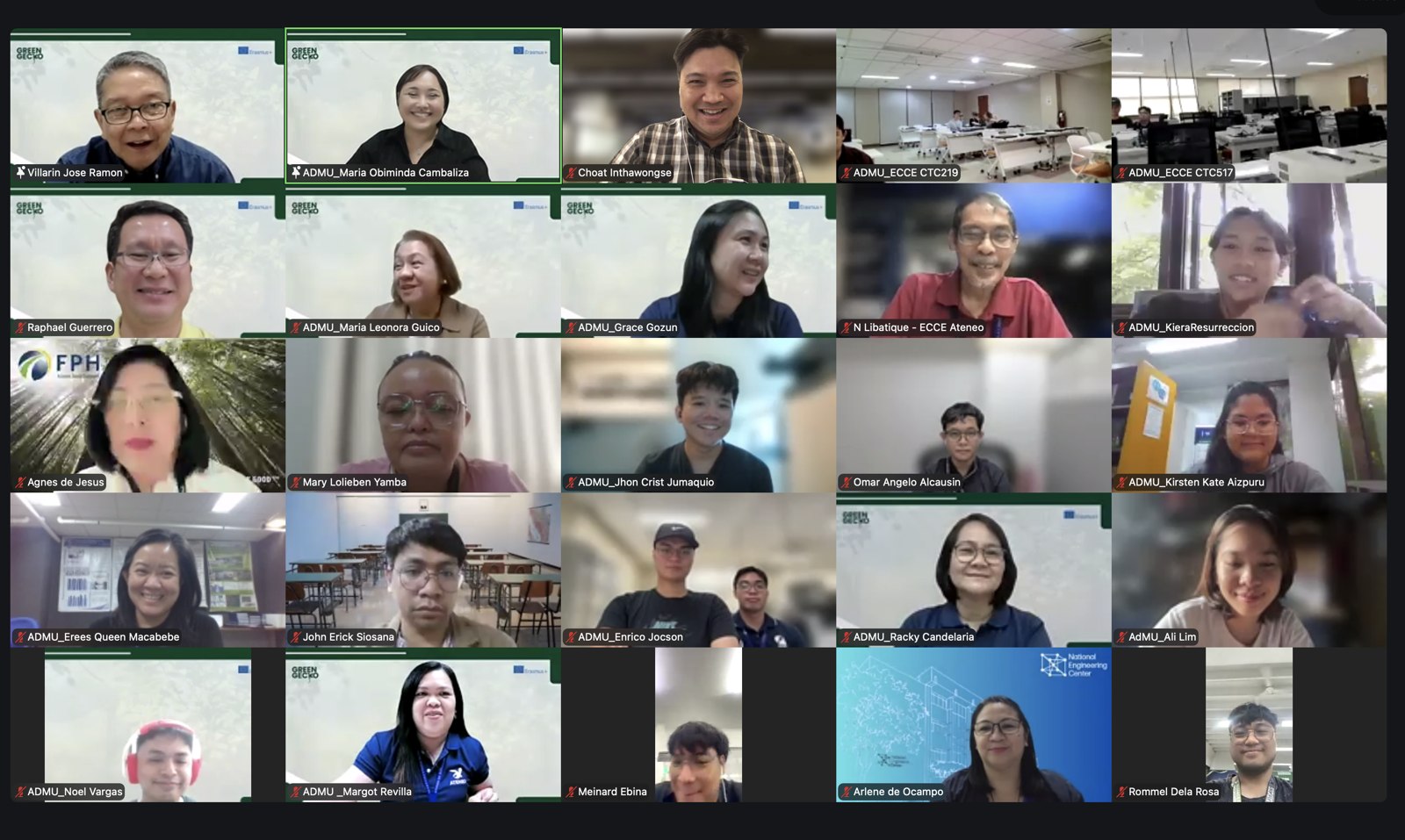
MANILA, Philippines — The Erasmus+ co-funded Green GECKO project launched its four-part international webinar series on Wednesday, September 23, 2026, convening an online audience of nearly 300 participants from Southeast Asia and Europe.

Hosted virtually via Zoom by Ateneo de Manila University (ADMU), the opening session titled "Climate Change and Greenhouse Gas Emissions: Global and ASEAN Contexts" drew undergraduate and postgraduate engineering students across multiple disciplines, alongside academic faculty and sustainability professionals. The session addressed the physical science of global warming, regional vulnerability across Southeast Asia, and the imperative for engineering-led decarbonization.

Keynote Address: Bridging Atmospheric Science and Engineering Solutions

The keynote address was delivered by distinguished climate scientist Fr. Jose Ramon T. Villarin, SJ, Executive Director of the Manila Observatory. Drawing on his extensive experience as an atmospheric physicist and contributor to the Nobel Peace Prize-winning Intergovernmental Panel on Climate Change (IPCC), Fr. Villarin examined the direct nexus between climate data and engineering system design:

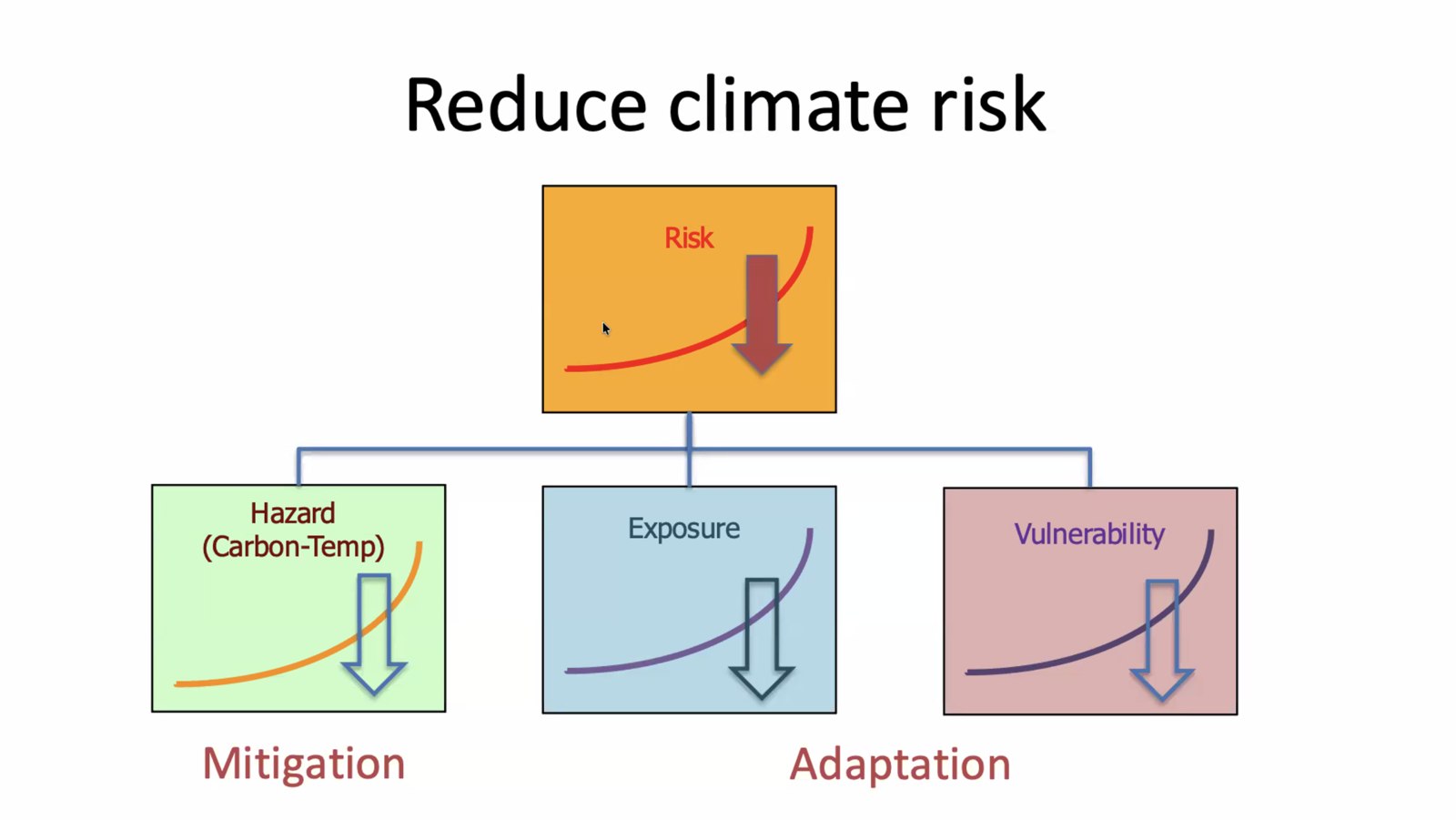
Climate Science & Regional Vulnerabilities: Outlining recent atmospheric warming trends, sea-level rise projections, and the intensified climate risks faced by ASEAN coastal settlements, energy systems, and agricultural supply chains.

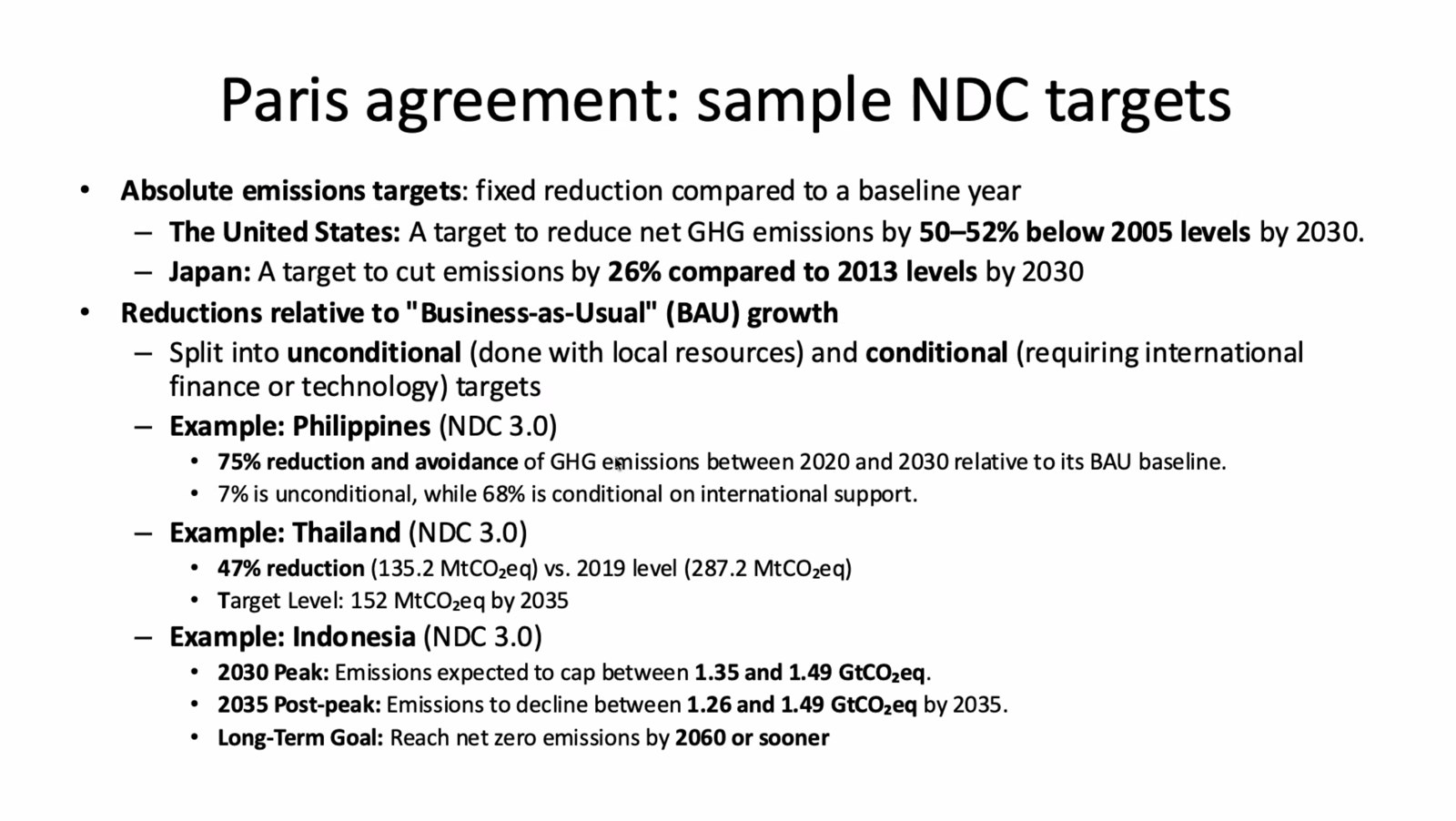
International Frameworks & Decarbonization Targets: Breaking down the role of the Paris Agreement, Nationally Determined Contributions (NDCs), and industrial carbon accountability frameworks in driving regional energy transition.

GHG Emission Hotspots in Engineering: Analyzing major emission sources across industrial manufacturing, power generation, infrastructure development, and transportation networks, while spotlighting technological interventions to mitigate emissions at the design stage.

Interactive Dialogue with Future Engineers

With nearly 300 attendees tuned in, the presentation transitioned into an active, highly engaging Q&A segment. Engineering students and early-career researchers questioned how localized carbon accounting, circular manufacturing principles, and clean technology adoption can be embedded into everyday engineering operations across Thailand, the Philippines, and the broader ASEAN region.

The thematic content covered during the session directly underpins Module 1 (Introduction and Importance of Climate Change) and Module 2 (Climate Policy, International Framework, and Sources of GHG Emissions in Engineering Systems), two foundational courses currently being finalized by consortium partner universities.

Upcoming Sessions in the Green GECKO Series

Following the strong turnout for the launch event, the consortium will continue its international webinar series throughout September and October 2026, leading toward the project's first in-person training session at the UniversitÃĐ de Montpellier in late November:

Topic 2: GHG and Carbon Footprint Accounting (Host: Burapha University / Thailand)

Topic 3: Energy Management and Low-Carbon Technologies (Host: EU / International Expert)

Topic 4: Net Zero Engineering and Circular Economy (Host: EU / International Expert)

About the Project

The Green GECKO project (Capacity Building in Higher Education) is co-funded by the Erasmus+ Programme of the European Union and led by the University of Montpellier (France). The consortium brings together 12 institutions—including European partners Politecnico di Torino (Italy), UNED (Spain), and Vilnius University (Lithuania), alongside leading universities from Thailand (Burapha, Kasetsart, Silpakorn, Ubon Ratchathani) and the Philippines (Ateneo de Manila, TIP, UP, Xavier)—to design and implement modern curricula focused on sustainability, climate resilience, and carbon neutrality.

Back to activities ↑